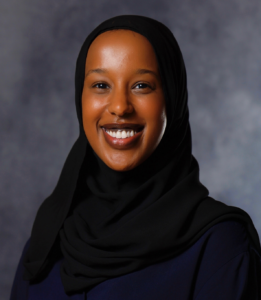
Dr. Nima Dahir (The Ohio State University) has been selected to receive the 2026 Alma H. Young Emerging Scholar Award.
This annual award is given to a promising Ph.D. candidate or early-career researcher whose work demonstrates a commitment to rigorous and impactful research and service. It was renamed in 2004 in honor of Alma H. Young to commemorate her long-standing service to the Urban Affairs Association (UAA) and her particular commitment to mentoring graduate students and junior faculty.
AWARD COMMITTEE ASSESSMENT
The review committee has selected Nima Dahir as the winner of the Urban Affairs Association (UAA) Alma H. Young Emerging Scholar Award. Nima’s strong research agenda has integrated her own lived experience alongside commitments to community engagement and social and racial justice, and her work has been featured in high quality urban studies and sociology publication venues including The Russell Sage Foundation Journal of the Social Sciences, City & Community, Socius, and the Journal of Ethnic and Migration Studies.
A thorough, glowing letter of recommendation from Prof. Jackie Hwang demonstrates the depth of Nima’s methodological pursuits focused on an under-researched topic: the intersection of race and immigration at the level of the urban neighborhood. In the spirit of Dr. Alma H. Young, the committee found that Nima’s work demonstrates an exceptional commitment to rigorous and impactful research and service.
AWARD RECIPIENT BIO
Nima Dahir is a Provost’s Fellow and Assistant Professor of Sociology at The Ohio State University, where she is also a faculty affiliate with the Institute for Population Research and the Kirwan Institute for the Study of Race and Ethnicity. She studies how race and immigrant status shape neighborhood choice and change in American cities. Focusing on Black immigrants and Black refugees, she examines where they live, how they reshape these places, and how these places shape their racial identity and broader patterns of inequality.
Her scholarship bridges urban sociology, migration, and stratification. In work published in leading urban studies and migration journals, she uses a range of approaches, including computational methods, administrative data, and ethnography. In addition, she is co-editor of the forthcoming edition of Social Stratification. Beyond her publications, Dahir partners with local immigrant and refugee organizations to ensure her research reflects and informs the experiences of Black immigrant residents. She received her PhD in sociology from Stanford University and dual bachelor’s degrees in mathematics and economics from The Ohio State University.
AWARD PRESENTATION
The formal presentation of this award will be made at the upcoming International Conference on Urban Affairs in Chicago, Illinois. The theme of this year’s conference is No Little Plans: Realizing Urban Futures in Times of Crisis. The conference will convene over 1100 participants from 55+ countries and representing 20+ fields of study. All award recipients will be formally recognized for their achievements during the Awards and Recognition Program on April 29, 2026; 3:00 – 4:15pm.
AWARD COMMITTEE MEMBERS
Stefan Chavez-Norgaard, University of Denver (Chair); Anna Livia Brand, University of California, Berkeley; Tyler Haupert, NYU Shanghai; Matthew McLeskey, Oswego State College, SUNY; Stacy Moak, University of Alabama Birmingham
ABOUT THE URBAN AFFAIRS ASSOCIATION
The Urban Affairs Association (UAA) is an international professional organization for 1000+ urban scholars, researchers, policy analysts, & public service providers. UAA is dedicated to creating interdisciplinary spaces for engaging in intellectual and practical discussions about urban life. Through theoretical, empirical, and action-oriented research, UAA fosters diverse activities to understand and shape a more just and equitable urban world.
In addition to hosting an annual conference, UAA sponsors ongoing professional development opportunities; Upsilon Sigma: The Urban Studies Honor Society; and two peer-reviewed journals, the Journal of Urban Affairs and the Journal of Race, Ethnicity and the City. You can find UAA on the web, LinkedIn, Bluesky, Facebook, and X.